


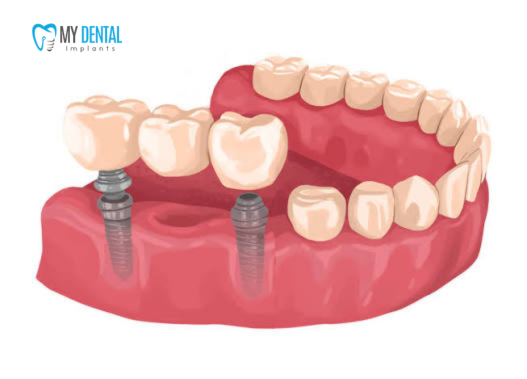
An implant-supported bridge is a set of replacement teeth fixed permanently to two or more dental implants instead of your natural teeth. It’s used to replace three or more missing teeth in a row without grinding down healthy teeth on either side, as a traditional bridge requires. In Auckland, an implant-supported bridge typically costs from $7,250 and lasts 15–25+ years with proper care — often a lifetime for the implants themselves.
That’s the short answer. Below, we break down exactly how it works, who it’s right for, what it costs, and what to expect at every stage — so you can walk into your consultation already informed.
What Is an Implant-Supported Bridge?
An implant-supported bridge replaces several missing teeth in a row using two types of crowns:
- Retainer crowns — the end crowns, each anchored directly to a dental implant.
- Pontics — the crowns in between, which don’t need their own implant; they’re suspended between the retainer crowns.
A common setup uses two implants to support three teeth — one implant at each end, with a pontic tooth bridging the gap. Because implants act as artificial tooth roots embedded in the jawbone, the bridge doesn’t rely on your remaining natural teeth for support at all.
Implant-Supported Bridge vs. Traditional Bridge vs. Implant-Supported Denture
| Implant-Supported Bridge | Traditional Bridge | Implant-Supported Denture | |
|---|---|---|---|
| Support | Dental implants only | Adjacent natural teeth | Multiple implants |
| Natural teeth affected | None — neighbouring teeth untouched | Neighbouring teeth are filed down | None |
| Prevents bone loss | Yes — stimulates jawbone | No | Yes |
| Typical lifespan | 15–25+ years | 5–10 years | 15+ years |
| Best for | 3+ missing teeth in a row, healthy jawbone | Budget-conscious, short-term fix | Most or all teeth missing in an arch |
| Starting cost (NZ) | From $7,250 | From ~$1,500–2,500 per tooth | Varies by arch |
if you’re missing three or more teeth in a row and want a permanent, bone-preserving solution that doesn’t touch your remaining healthy teeth, an implant-supported bridge is usually the stronger long-term investment over a traditional bridge.
Who Is a Good Candidate?
You’re likely a good candidate for an implant-supported bridge if you:
- Are missing three or more adjacent teeth
- Have enough healthy jawbone to anchor implants (or are eligible for a bone graft)
- Have healthy gums and no untreated periodontal disease
- Don’t smoke heavily, or are willing to quit during healing (smoking significantly slows implant integration)
- Are in general good health for minor oral surgery
A 3D bone scan and consultation confirm candidacy before treatment begins.
The Procedure: Step by Step
- Consultation and 3D bone scan — Your dentist assesses bone quality, quantity, and gum health to plan implant placement.
- Implant placement surgery — Implants are placed into the jawbone in a single session, usually under local anaesthetic. A temporary bridge may be fitted so you’re never without teeth.
- Osseointegration (healing period) — Over roughly 3–6 months, the jawbone fuses to the implants, creating a stable foundation. This is the step that can’t be rushed — it’s what makes the bridge last decades.
- Impressions — Once integration is confirmed, a digital or physical impression is taken to custom-make your permanent bridge.
- Bridge fitting — The final bridge is attached to the implants, usually over one to two visits, and adjusted for bite and comfort.
Most patients need 2–4 appointments total, spread across the healing period.
How Much Does an Implant-Supported Bridge Cost in Auckland?
Pricing starts from $7,250 in Auckland and varies based on:
- Number of implants and pontics required
- Whether a bone graft is needed first
- Material choice (porcelain, zirconia, etc.)
- Complexity of your case
Because the implants themselves rarely need replacing, the lifetime cost is often lower than repeatedly replacing a traditional bridge every 5–10 years. Book a consultation for an exact quote based on your mouth.
How Long Does an Implant-Supported Bridge Last?
With good oral hygiene and regular check-ups, the implants can last a lifetime, while the bridge (crown) portion typically lasts 15–25 years before it may need replacing due to normal wear. This compares favourably to traditional bridges, which typically need replacing every 5–10 years as supporting teeth weaken.
Aftercare: How Do You Clean an Implant-Supported Bridge?
- Brush twice daily with a soft-bristled brush, angling under the bridge
- Use a water flosser or super floss designed to clean beneath the pontic
- Avoid biting directly into very hard foods (ice, hard candy) with the bridge
- Attend a check-up every six months so your dentist can monitor implant and gum health
- Watch for gum redness, swelling, or bleeding around the implants — early signs of peri-implant infection are easiest to treat
Frequently Asked Questions
Q.1 Is getting an implant-supported bridge painful?
Ans:Most patients report mild discomfort for a few days after surgery, manageable with over-the-counter pain relief — not significant pain. Local anaesthetic is used during the procedure itself.
Q.2 Can I get an implant-supported bridge if I’ve lost bone in my jaw?
Ans: Often, yes — a bone graft can rebuild sufficient bone before implants are placed. Your 3D scan will determine if this extra step is needed.
Q.3 Does insurance or ACC cover implant-supported bridges in New Zealand?
Ans. Standard health insurance rarely covers implants unless tooth loss was due to an accident, in which case ACC may contribute. Check your individual policy and discuss options at your consultation.
What’s the difference between a pontic and a retainer crown? A retainer crown attaches directly to an implant; a pontic is the “floating” replacement tooth suspended between retainer crowns, with no implant of its own.